What Is an HS Code? Meaning, Structure and Examples
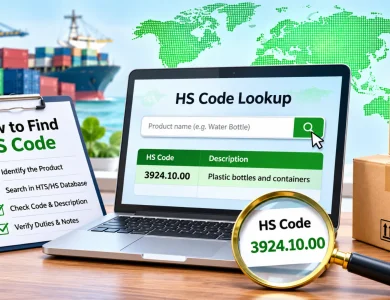
Imagine you are importing 500 reusable water bottles from an overseas supplier for your online store. You have already negotiated the price, confirmed the quantity, and arranged shipping, but your freight forwarder suddenly asks for the product’s HS code. You check the commercial invoice and find the product description, quantity, weight, and total value, but there is no classification number. When you search online, several different codes appear, and each seems related to your product. This situation is common in international trade, especially for people handling their first commercial shipment.
The confusion usually begins because businesses identify products by their names, while customs authorities classify them according to standardized legal descriptions. A supplier might describe an item as a travel bottle, drinking container, or reusable flask, but those names alone may not establish its correct customs classification. The material, construction, intended function, and applicable classification rules can all make a difference. Selecting an incorrect code can lead to customs questions, inaccurate duty calculations, or delays in clearing goods through customs.
Understanding what is HS code, how its structure works, and where to find the correct classification can make international shipping much easier to manage. Whether you are an importer, exporter, e-commerce seller, freight forwarder, or someone learning about global trade, the Harmonized System provides the foundation for identifying products across international borders.
What Is an HS Code?
An HS code, short for Harmonized System code, is an internationally standardized numerical classification used to identify products traded between countries. It belongs to the Harmonized Commodity Description and Coding System, which is developed and maintained by the World Customs Organization (WCO). The system organizes thousands of traded products into chapters, headings, and subheadings so that customs authorities can classify goods using a common international framework. This helps countries administer customs duties, compile trade statistics, and apply relevant trade measures.
The international Harmonized System uses a six-digit classification structure, although individual countries may add more digits to meet their domestic customs and statistical requirements. For example, the United States uses the Harmonized Tariff Schedule of the United States (HTSUS), which extends the international system to include additional national subdivisions. The European Union uses its own commodity classification system, including the Combined Nomenclature, while the United Kingdom maintains its national tariff classifications. These systems share the international HS foundation but can differ beyond the first six digits.
An important point is that an HS code classifies the type of goods rather than identifying an individual product in the same way as a barcode or stock-keeping unit (SKU). Two companies selling the same type of merchandise may use the same HS classification even though their products have different brand names, model numbers, packaging, and retail prices. However, seemingly similar products can belong to different classifications when their materials, construction, or functions differ. That is why understanding the product itself is essential before deciding which classification applies.
What Does HS Code Stand For?
HS stands for Harmonized System, and the complete name of the classification framework is the Harmonized Commodity Description and Coding System. The World Customs Organization administers this international system and periodically updates it to reflect changes in traded goods and classification requirements. Governments use the system as the basis for their national customs tariff schedules, allowing products to be identified through a standardized structure rather than relying only on commercial descriptions.
The idea behind the system is relatively simple. A business in one country might describe a product differently from a supplier in another country, particularly when the two companies use different languages or industry terminology. An internationally recognized commodity classification helps reduce that confusion by linking products to standardized categories. However, customs authorities still need accurate product information and must apply the legal classification rules to determine the appropriate code.
Why Are HS Codes Important in International Trade?
HS codes play an essential role in international trade because they connect the physical characteristics of imported or exported products with the customs rules that apply to those goods. Without a reliable classification system, customs authorities would have difficulty applying tariff schedules consistently across the enormous variety of products entering international markets. The Harmonized System provides a shared starting point for those decisions, although each country may apply its own national tariff provisions and trade regulations.
1. Determining Customs Duties and Tariffs
One of the main purposes of an HS code is to help determine which tariff classification applies to imported goods. Customs duties are generally assessed using the relevant national tariff schedule, and product classification is one of the factors involved in identifying the applicable rate. For example, products made from different materials may fall under different tariff provisions even when they serve a similar purpose. A plastic drinking container and a vacuum-insulated stainless-steel flask should not automatically be treated as the same product for classification purposes.
However, the HS code alone does not determine the final import cost. The country of origin, customs value, applicable trade agreements, additional duties, and other trade measures may also affect the amount payable. A shipment imported into the United States may therefore require more than simply locating the standard duty rate in the tariff schedule. Importers should review all relevant requirements before estimating their landed costs.
2. Supporting Customs Clearance
Customs clearance involves declaring imported or exported goods and providing the information required by the relevant customs authority. Commodity classification is an important part of that process because it helps identify the merchandise being declared. Depending on the country and type of shipment, customs documentation may require national tariff codes, product descriptions, quantities, customs values, and country-of-origin information.
When the classification is incorrect or inconsistent with the product description, customs authorities may request clarification or additional supporting documentation. This can delay the release of goods and create extra administrative work for importers, exporters, or their customs representatives. Correct classification does not guarantee immediate customs clearance, but it helps establish the accurate information needed for processing the shipment.
3. Identifying Product-Specific Trade Requirements
Certain products are subject to additional import restrictions, permits, inspections, or government agency requirements. Commodity classifications can help businesses identify which rules may be relevant to their goods, although the classification itself does not establish every regulatory obligation. For example, food products, chemicals, medical products, and certain electronic devices can be subject to requirements beyond ordinary customs duties.
Businesses should therefore treat HS classification as one part of a wider compliance process. A product may have a valid tariff classification but still require additional documentation or approval before importation. Reviewing the applicable product regulations alongside the tariff schedule can help avoid unexpected problems during customs clearance.
4. Supporting International Trade Statistics
Governments and international organizations use Harmonized System classifications to collect and analyze international trade data. By grouping products under standardized commodity categories, statistical agencies can measure the quantities and values of goods imported or exported. This information is useful for understanding global supply chains, comparing trade between countries, and identifying changes in demand for particular types of merchandise.
Businesses can also use commodity-level trade statistics when researching new markets or reviewing international sourcing opportunities. However, broad HS categories do not always provide the level of product detail needed for a specific business decision. The usefulness of trade statistics depends on the classification level, the available data, and the accuracy of the underlying declarations.
How Is an HS Code Structured?
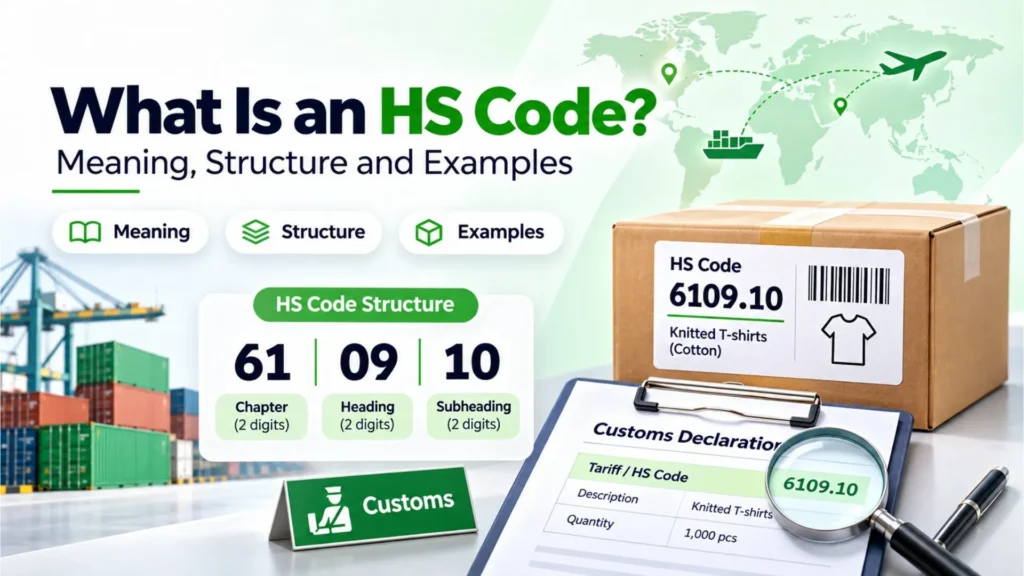
The international Harmonized System uses a six-digit structure that organizes products into chapters, headings, and subheadings. Rather than assigning unrelated numbers to individual products, the system follows a hierarchy in which each level provides a more specific classification. The first two digits identify the chapter, the first four digits identify the heading, and the complete six digits identify the international subheading. This arrangement allows countries to use a shared foundation when classifying traded merchandise.
For example, consider HS code 0807.11, which covers fresh watermelons. The first two digits, 08, refer to the chapter covering edible fruit and nuts, including certain fruit peel. The first four digits, 0807, identify the heading for fresh melons and papayas. The complete six-digit subheading, 0807.11, identifies fresh watermelons within that heading.
| HS code level | Example | Classification description |
|---|---|---|
| Chapter | 08 | Edible fruit and nuts; peel of citrus fruit or melons |
| Heading | 0807 | Melons and papayas, fresh |
| Subheading | 0807.11 | Watermelons |
This structure is useful because it shows how a broad product group becomes more specific as additional digits are considered. However, the numerical hierarchy should not be mistaken for a simple keyword directory. The Harmonized System contains legal descriptions, section notes, chapter notes, and interpretation rules that govern classification. A product should be classified according to those rules rather than by selecting the first number that appears to match its commercial name.
What Is the Difference Between 6-Digit, 8-Digit, and 10-Digit HS Codes?
A common source of confusion is the number of digits required for international shipments. Some suppliers provide six-digit HS codes, while freight forwarders and customs brokers may ask for eight-digit or ten-digit tariff numbers. These differences exist because the international Harmonized System establishes the first six digits, while individual countries can create additional subdivisions for their customs tariffs and statistical reporting. The exact number of digits required depends on the destination country and the applicable customs procedure.
In the United States, the Harmonized Tariff Schedule extends the international six-digit structure to eight-digit legal tariff provisions. Two additional digits provide statistical reporting subdivisions, creating the ten-digit HTSUS numbers used for US import entry reporting. The eight-digit tariff provisions are important for identifying the applicable legal tariff classification, while the complete ten-digit numbers support the country’s import reporting requirements.
| Classification | Number of digits | Primary purpose |
|---|---|---|
| International HS code | 6 | International commodity classification |
| US HTS tariff provision | 8 | US legal tariff classification |
| US HTS statistical reporting number | 10 | US import entry reporting |
| EU Combined Nomenclature | 8 | EU tariff and statistical classification |
| EU TARIC code | Typically 10 | EU integrated tariff measures |
The main lesson is that a six-digit international HS code and a complete national tariff code are not always interchangeable. A supplier in China may provide a classification containing additional digits used in the Chinese tariff system, but those extended digits should not automatically be used for a US import declaration. Importers should confirm the appropriate national classification for the country where the goods are entering customs.
HS Code Examples for Common Products
Looking at common products can help explain how goods are organized under the Harmonized System. However, product examples should be treated as illustrations rather than final classification recommendations. A commercial product name does not always reveal the material, construction, or other characteristics needed to determine a complete classification. This is particularly important for manufactured goods that may fit several possible descriptions.
| Product | Example HS code | Description |
|---|---|---|
| Fresh watermelons | 0807.11 | Watermelons, fresh |
| Wheat and meslin | 1001 | Heading for wheat and meslin |
| Coffee | 0901 | Heading covering coffee and certain related products |
| T-shirts | 6109 | Heading for certain knitted or crocheted T-shirts and similar garments |
For example, heading 6109 covers certain T-shirts and similar garments, but additional classification details may depend on the material and construction of the clothing. The final US reporting number can also require more information than the general product description provides. Similarly, coffee falls under heading 0901, but its specific classification depends on characteristics such as whether it has been roasted or decaffeinated.
The example of reusable water bottles is particularly helpful because it demonstrates why a product’s intended use alone may not settle its classification. Bottles may be manufactured from plastic, glass, stainless steel, or other materials, and some may incorporate vacuum insulation or additional functions. These differences can direct the classification research toward different parts of the tariff schedule. A careful importer therefore starts with the product specifications rather than assuming that every item sold as a water bottle shares the same code.
How to Find the Correct HS Code for Your Product
Finding the correct HS code starts with understanding the product and then researching its classification in the official tariff schedule. Search engines and third-party databases can help identify possible codes, but they should not replace the legal descriptions and official guidance that govern customs classification. For businesses importing goods into the United States, the US International Trade Commission provides access to the Harmonized Tariff Schedule, while US Customs and Border Protection (CBP) provides classification guidance and binding rulings.
Step 1: Collect Complete Product Information
Before searching for an HS code, gather the information needed to describe the product accurately. This may include its material composition, intended function, technical specifications, manufacturing details, and whether it is a finished article or a component. Product photographs, technical sheets, and supplier specifications can also help identify characteristics that matter for classification. The more precise the product description, the easier it becomes to evaluate potentially relevant tariff provisions.
For example, a description such as “reusable bottle” provides very little information about the actual merchandise. A more useful description would explain whether the bottle is made from stainless steel, has vacuum insulation, includes a drinking lid, and is intended for storing beverages. These details can help narrow the classification search and avoid confusion with products that have different materials or functions.
Step 2: Search the Official Harmonized Tariff Schedule
For US imports, visit the official US Harmonized Tariff Schedule and search for a description related to your product. Begin with the product’s main characteristics rather than copying a lengthy marketplace listing into the search field. Review the possible headings and subheadings, then examine their descriptions to determine which provisions could apply. The objective at this stage is to identify relevant classification possibilities, not to select a code simply because its wording appears similar.
The USITC maintains the published tariff schedule, but CBP is responsible for interpreting and enforcing tariff classifications for US imports. That distinction matters because an online tariff search can help you locate possible provisions without providing a binding decision about your particular product. Importers should therefore treat the search results as part of a broader classification process.
Step 3: Review the Legal Notes and Classification Rules
After identifying possible headings, examine the relevant section notes, chapter notes, and tariff descriptions. The Harmonized System uses the General Rules for the Interpretation of the Harmonized System, commonly called the GRIs, to determine how goods should be classified. These rules establish the legal framework for evaluating competing provisions and identifying the appropriate classification.
This step can be particularly important when products contain multiple materials or perform more than one function. A search result may initially appear suitable, but the relevant legal notes could establish an exclusion or point toward another heading. Reviewing the rules helps reduce the risk of selecting a tariff code based only on a familiar product name.
Step 4: Check Relevant CBP Classification Rulings
If classification remains uncertain, review the CBP Customs Rulings Online Search System (CROSS). This database contains published customs rulings that can help explain how CBP has classified particular products under US tariff provisions. Searching for goods with similar characteristics may reveal which technical details or interpretation rules influenced the decision.
However, a ruling involving another product should not automatically be treated as a binding determination for your shipment. Even small differences in materials, construction, or intended function may affect classification. You should also check whether a ruling has been modified, revoked, or otherwise affected by later developments. Where greater certainty is required, an eligible party can request a binding ruling directly from CBP.
Step 5: Verify the Complete National Tariff Code
Once you have identified a likely HS classification, verify the applicable national tariff code and any additional reporting digits. For US imports, this means checking the relevant HTSUS provision and ten-digit statistical reporting number. Importers should also review the tariff schedule’s duty information, units of quantity, and any additional provisions or trade measures that may apply.
It is important not to assume that the ordinary duty rate shown beside an HTS provision represents the complete import cost. Additional duties, trade remedies, preferential treatment, or other requirements may affect the final calculation. The classification should be checked alongside the applicable country-of-origin and customs valuation rules.
Step 6: Consult a Customs Professional When Necessary
Some products can be classified with relatively straightforward research, while others require detailed technical knowledge and interpretation of tariff provisions. Machinery, electronic devices, chemical products, composite articles, and specialized industrial goods may involve more complicated classification questions. Where an error could create significant financial or compliance risks, consulting a licensed customs broker or qualified trade adviser can be worthwhile.
Professional assistance is particularly useful for businesses importing the same products repeatedly. Clarifying a classification before the first shipment may reduce the likelihood of repeating the same error across multiple customs entries. In the United States, obtaining a binding ruling from CBP may provide greater certainty for the merchandise described in the ruling.
Practical Example: Finding an HS Code for Imported Water Bottles
Consider a US-based e-commerce business that plans to import 1,000 reusable drinking bottles from an overseas manufacturer. The supplier sends a commercial invoice describing the goods as “Reusable Travel Bottles” and includes a tariff code used for exports from the supplier’s country. The buyer assumes that the same number can be used for customs clearance in the United States. However, the supplier’s national tariff code may contain additional digits that do not correspond to the US HTSUS classification.
The first step would be to gather complete product information from the manufacturer. The buyer should confirm whether the bottles are plastic or stainless steel, whether they are vacuum insulated, how they are constructed, and what their primary function is. With those details available, the importer or customs broker can search the US Harmonized Tariff Schedule and evaluate the relevant headings and legal notes.
If several possible classifications remain, the importer can research published CBP rulings involving comparable products. The identified classification should then be checked against the current US tariff schedule, including any applicable duty provisions and additional trade measures. This process does not guarantee a particular customs outcome, but it provides a more reliable basis for declaring the goods than copying a foreign tariff number without verification.
The practical lesson is that supplier-provided HS codes should be treated as useful reference information rather than unquestionable final answers. A supplier may correctly classify merchandise for its own country’s export requirements while the importing country uses different national subdivisions. Taking the time to verify the destination country’s classification helps prevent avoidable mistakes during customs entry preparation.
Common HS Code Mistakes to Avoid
Selecting an HS code may appear simple when a product has a familiar name, but several common mistakes can create problems during customs clearance. Most of these errors begin when an importer relies on incomplete product information or treats an online search result as a confirmed classification. Understanding these mistakes can help businesses improve their research process and maintain more accurate trade records.
Using a Supplier’s HS Code Without Verification
Many suppliers provide commodity codes on commercial invoices or other shipping documents, which can be useful when researching a product. However, a supplier’s code may include national tariff subdivisions that are not valid in the destination country. The supplier may also have classified the goods using incomplete information or under a different tariff interpretation. Importers should therefore verify the applicable classification before relying on it for their own customs declarations.
Choosing a Code Based Only on the Product Name
A broad product description does not always provide enough information to establish the correct classification. For example, searching for “storage container” may return provisions covering products made from different materials and intended for different purposes. Choosing the first result without reviewing the legal descriptions can lead to mistakes. Product specifications, classification rules, and relevant legal notes should guide the final decision.
Ignoring Country-Specific Tariff Digits
The international six-digit Harmonized System provides a shared foundation, but individual countries may extend it differently. A ten-digit classification used by one country may not match the ten-digit reporting number required in another. Businesses that import and export between several markets should maintain appropriate country-specific classifications where necessary. This can help avoid errors when preparing customs documentation for different jurisdictions.
Confusing HS Codes With Country of Origin
HS classification and country of origin are related to customs treatment, but they describe different things. The HS code identifies the category of merchandise, while origin rules determine the country associated with the goods for particular customs purposes. A product’s classification does not automatically establish its origin, and a supplier’s shipping location may not necessarily determine where the product legally originates. Both details should be evaluated when calculating duties or reviewing trade agreement eligibility.
Relying on Outdated Tariff Information
Customs tariff schedules, statistical classifications, and trade measures can change over time. A code or duty rate found in an old blog post may no longer reflect current requirements, particularly when the product is affected by a tariff schedule amendment or additional trade measure. Importers should consult the current official tariff schedule and relevant government notices before preparing customs declarations. Maintaining accurate classification records is useful, but those records should be reviewed when regulations or product specifications change.
Where Can You Find HS Codes for Free?
Several official resources provide information about the Harmonized System and national customs classifications. For US importers, the most useful starting point is the US International Trade Commission’s online Harmonized Tariff Schedule, which provides the current published tariff structure. CBP also offers guidance and classification rulings that can help explain the interpretation of particular tariff provisions. For broader international information, the World Customs Organization provides educational resources about the Harmonized System itself.
| Official resource | Main purpose | Website |
|---|---|---|
| US International Trade Commission | Search the US Harmonized Tariff Schedule | hts.usitc.gov |
| US Customs and Border Protection | Customs guidance and classification rulings | cbp.gov |
| CBP CROSS | Search published customs rulings | rulings.cbp.gov |
| World Customs Organization | Learn about the international Harmonized System | wcoomd.org |
Third-party classification tools and commercial databases may also help identify potential codes, particularly when searching across several countries. However, their recommendations should be checked against the current official tariff schedules and applicable classification rules. For goods involving significant duties or regulatory risks, official guidance or a binding ruling may be more appropriate than relying entirely on automated suggestions.
Final Thoughts
Understanding what an HS code is can make international trade documentation much easier to approach, particularly for businesses importing products for the first time. The Harmonized System provides a common international framework for classifying goods, while national tariff schedules add the details needed for customs duties and statistical reporting. Although the numerical structure is relatively simple, identifying the correct classification requires more than searching for a product name. Materials, construction, intended function, legal notes, and national tariff provisions can all affect the result.
For US importers, a sensible starting point is to collect complete product information and research the relevant provisions in the official US Harmonized Tariff Schedule. Published CBP rulings can provide additional context when the classification is unclear, and qualified customs professionals can assist with more complicated products. Taking these steps before preparing an import declaration can help reduce avoidable classification errors and improve the accuracy of customs documentation. The most useful approach is to treat HS code research as part of normal import planning rather than as a number to fill in at the last minute.
Disclaimer: This article is intended for general educational purposes only and does not constitute legal, customs brokerage, or tax advice. Always verify classifications, duty rates, and regulatory requirements using official sources or qualified professional guidance.
Frequently Asked Questions About HS Codes
What is an HS code in simple terms?
An HS code is a standardized numerical classification used to identify products traded internationally. The system groups merchandise into categories based on legally defined product descriptions and classification rules. Customs authorities use this framework to support tariff administration, trade statistics, and other customs procedures. The international system contains six digits, while individual countries may add further subdivisions.
Is an HS code the same in every country?
The six-digit Harmonized System framework is internationally standardized among countries using the same edition of the system. However, countries may add further digits to create more detailed national classifications, so complete tariff numbers can differ. Countries may also apply different duty rates and import requirements to goods under corresponding international HS classifications. Importers should use the official tariff schedule for the country where the merchandise will be cleared.
How many digits are in an HS code?
The internationally standardized HS classification contains six digits, divided into a two-digit chapter, four-digit heading, and six-digit subheading. Many countries extend this structure to eight, ten, or more digits for national tariff and statistical purposes. In the United States, the HTSUS uses eight-digit legal tariff provisions and ten-digit statistical reporting numbers. The required number of digits depends on the customs system and procedure involved.
Can I use the HS code provided by my supplier?
A supplier’s HS code can be a helpful starting point, but it should be checked before being used in a customs declaration. The supplier may have provided a classification based on its own country’s tariff system or may not have considered all relevant product characteristics. Additional national digits can also differ between exporting and importing countries. Importers should verify the classification against the official tariff schedule and applicable legal rules in the destination country.
What happens if the wrong HS code is used?
An incorrect HS classification can result in inaccurate duty calculations, customs questions, additional documentation requests, or clearance delays. Depending on the circumstances and applicable laws, classification errors may also lead to duty adjustments or penalties. The consequences depend on the nature of the error and how it is addressed. Businesses should correct identified classification issues through the appropriate customs procedures and seek professional assistance where necessary.
What is the difference between an HS code and an HTS code?
An HS code refers to the international six-digit Harmonized System classification maintained by the World Customs Organization. In the United States, the HTSUS expands that framework with additional digits for national tariff and statistical purposes. The first six digits provide the international foundation, while the additional digits identify more detailed US classifications. This distinction matters when preparing import entry documents or researching applicable tariff provisions.
Is an HS code required for international shipping?
Commodity classification plays an important role in international shipping and customs declarations, although specific documentation requirements vary by country, shipment type, and customs procedure. Commercial import entries generally require the appropriate national tariff classification. Some transport documents may also include commodity information depending on the carrier and destination. Importers and exporters should confirm the exact requirements for their shipments with the relevant customs authority or logistics provider.