
What Is Customs Clearance? Process, Steps and Required Documents
Imagine you’ve ordered 300 kitchen accessories from an overseas manufacturer for your small online store. Your supplier confirms that the shipment has arrived in the United States, and the tracking page shows that the goods are at the destination port. You expect delivery within a few days, but instead, the freight forwarder sends a message saying the shipment is awaiting customs clearance. They also request a commercial invoice, packing list, and additional details about the products before arranging delivery.
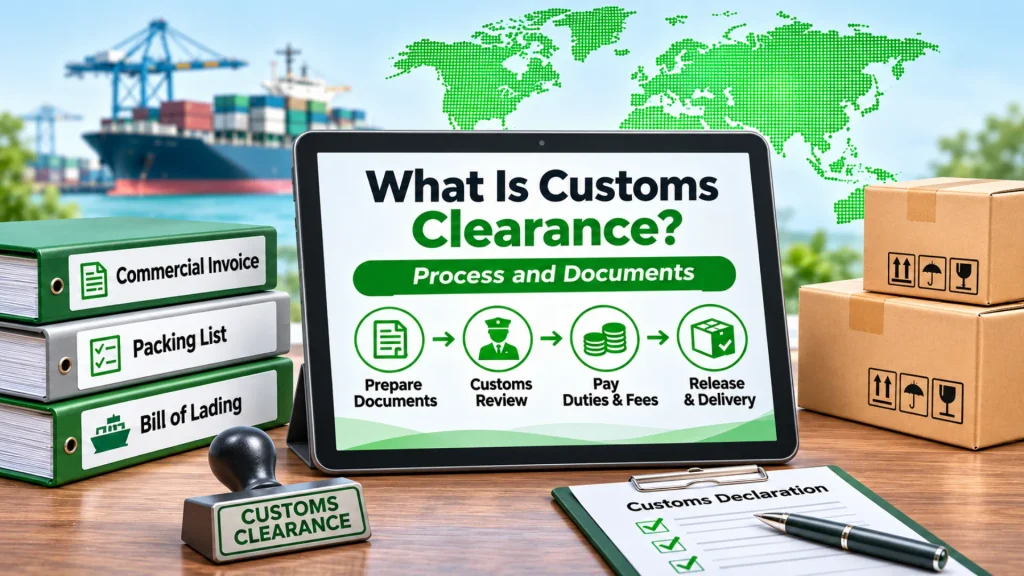
For someone importing goods for the first time, this can be confusing. The shipping company has already transported the products across the ocean, so why can’t the goods simply be delivered to your warehouse? The reason is that crossing an international border involves more than transportation. Customs authorities must review the shipment information, determine whether the goods can legally enter the country, and ensure the relevant import requirements have been satisfied.
Understanding what is customs clearance can help you avoid common shipping mistakes, prepare the correct documents, and make better decisions when importing products. Whether you’re an e-commerce seller, a small business owner, or someone receiving an international shipment, knowing how the process works makes it easier to understand why customs may request information and what needs to happen before delivery.
This guide explains customs clearance in simple terms, focusing mainly on the United States. You’ll learn how the clearance process works, which documents are commonly required, what customs brokers do, and why some shipments take longer than others. We’ll also look at practical scenarios and the mistakes that can create unnecessary delays.
What Is Customs Clearance?
Customs clearance is the process of completing the customs procedures required for goods to enter or leave a country. It generally involves providing shipment information, declaring the goods, complying with import or export regulations, and satisfying applicable duty and tax requirements. Customs authorities use this information to determine whether goods can be released and whether additional inspections, documentation, or regulatory checks are necessary.
In the United States, imported merchandise is regulated by US Customs and Border Protection (CBP). CBP reviews import entry information, administers customs laws, collects applicable duties and fees, and coordinates with other federal agencies where necessary. Products such as food, medical devices, agricultural goods, and certain electronic products may involve additional requirements beyond ordinary customs entry procedures.
The important distinction is that customs clearance and international shipping are not the same activity. A carrier transports goods from one location to another, while customs clearance addresses the legal requirements for bringing those goods into the destination country. Even if a container has arrived safely at a US port, it cannot simply enter domestic commerce unless the applicable customs release and entry requirements are satisfied.
For example, a shipment containing imported clothing may need accurate tariff classifications, product descriptions, origin information, and commercial values. If the details are complete and no additional review is required, CBP may authorize release through the normal entry process. If something is missing or the shipment is selected for examination, additional steps may be necessary before the goods can move onward.
Why Is Customs Clearance Important?
Customs clearance helps governments control the movement of goods across international borders while administering trade laws and collecting applicable revenue. Without customs procedures, authorities would have limited ability to verify shipment declarations, identify restricted merchandise, or apply the correct customs duties. For businesses, the process also creates an official record of imported goods and the information declared about them.
Ensuring Compliance With Import Regulations
Different products are subject to different import requirements. Ordinary household merchandise may have relatively straightforward documentation needs, while food products, chemicals, medical equipment, and certain agricultural goods can require additional regulatory information or agency review. Customs clearance provides a point at which the applicable requirements can be checked before the goods enter the domestic market.
Importers should therefore research product-specific requirements before shipping. A correctly completed customs declaration does not automatically resolve a missing import permit or a separate regulatory restriction. When an additional government agency regulates the merchandise, its requirements may need to be satisfied before release is authorized.
Determining Applicable Duties and Fees
Customs authorities use declared information to assess the financial obligations associated with imported merchandise. Important details include the tariff classification, customs value, country of origin, and any relevant preferential or additional trade measures. These factors help determine which duties, taxes, and fees apply to the shipment.
Businesses should not assume that the purchase price alone determines the final import cost. Customs valuation rules and applicable tariff measures may require a more detailed calculation. Understanding the expected duty exposure before ordering products can help importers estimate their landed costs and avoid unexpected expenses.
Preventing the Entry of Restricted Goods
Another purpose of customs procedures is to help enforce restrictions on merchandise that cannot legally enter a country or that requires special authorization. Certain products may be prohibited, subject to licensing requirements, or regulated by federal agencies. Customs authorities may review descriptions, supporting documents, and other available information to determine whether further checks are required.
This is especially relevant when importing unfamiliar products from overseas suppliers. A product may be widely available on an international marketplace but still be subject to specific US import requirements. Importers should not treat a supplier’s willingness to ship merchandise as proof that it is legally admissible.
How Does the Customs Clearance Process Work?
The customs clearance process generally begins before a shipment reaches its destination. Importers and their representatives need to identify the goods, collect supporting documents, and determine the appropriate entry procedure. In the United States, much of this information is submitted electronically through CBP systems, often with assistance from a licensed customs broker.
The exact process can vary depending on the merchandise, shipment value, transportation method, and applicable regulations. However, the following stages explain the typical steps involved in clearing a commercial shipment entering the United States.
Step 1: Prepare the Shipment Information
The first step is to collect accurate information about the products being imported. This usually includes the commercial invoice, product descriptions, quantities, values, country of origin, and relevant transportation details. The importer or customs broker also needs enough information to determine the appropriate tariff classification and identify any special requirements.
For example, if a business imports stainless-steel kitchen utensils, the supplier should provide descriptions that identify the actual products rather than vague phrases such as “kitchen items.” The materials, product types, quantities, and commercial values may all be relevant. Incomplete descriptions can make tariff research and customs entry preparation more difficult.
Preparing this information early is particularly useful when dealing with first-time suppliers. If the shipment arrives before the importer has the necessary documents, the goods may remain at the port or another authorized location while the missing information is obtained. Depending on the circumstances, this can create additional storage, handling, or transportation charges.
Step 2: Determine the Correct Customs Classification
Imported products must be classified under the applicable national tariff schedule. In the United States, the Harmonized Tariff Schedule of the United States (HTSUS) provides the legal tariff provisions and statistical reporting numbers used for import declarations. The correct classification depends on the merchandise and the relevant legal interpretation rules, not simply the commercial name provided by the supplier.
A product’s tariff classification is important because it helps determine the applicable duty provisions and may identify additional trade measures. For instance, different materials or product functions can lead to different tariff classifications even when two items appear similar. An importer should therefore verify the classification rather than automatically copying a code from an overseas invoice.
For additional guidance, read our article on how to find the correct HS code for a product. This topic explains the research process in greater detail, including the use of official tariff resources and classification rulings.
Step 3: Submit the Required Customs Entry Information
Once the shipment information is ready, the importer of record or an authorized customs broker submits the appropriate entry information to CBP. The entry procedure provides the information needed to identify the goods and determine whether they can be released. US imports are commonly processed electronically through the Automated Commercial Environment (ACE), although the applicable filing procedures depend on the entry type and circumstances.
For many commercial shipments, the entry process includes a cargo release filing and an entry summary. These are related but distinct parts of customs processing. Cargo release information supports the decision to release the merchandise, while the entry summary provides information used for duty assessment, statistics, and other legal requirements.
Importers should also understand that specific filing deadlines apply. CBP provides guidance about entry documentation and entry-summary timing, but the precise obligations can depend on the type of entry and other circumstances. A customs broker can help confirm which filings and deadlines apply to a particular shipment.
Step 4: Customs Reviews the Shipment
After the necessary information has been submitted, CBP evaluates the shipment using the available entry data and applicable enforcement procedures. Many shipments may move through normal processing without a physical examination, while others are selected for additional review. A request for information or examination does not automatically mean the importer has violated customs regulations.
Customs may need to verify product descriptions, tariff classifications, declared values, origin information, or compliance with another agency’s requirements. If additional documentation is requested, the importer or customs broker generally needs to respond before the matter can be resolved. The time required for review depends on the nature of the question and the information available.
For businesses importing products regularly, keeping organized shipment records can make this stage easier to manage. When invoices, specifications, purchase orders, and supplier correspondence are readily available, it is simpler to respond to questions. Poor recordkeeping can turn an otherwise manageable customs inquiry into a lengthy administrative problem.
Step 5: Customs May Inspect the Goods
Some shipments are selected for physical examination or other inspection procedures. An inspection may involve checking packages, verifying product characteristics, or reviewing information relevant to admissibility. Not every imported shipment is physically inspected, and the selection of a shipment for examination does not necessarily indicate wrongdoing.
Inspections can affect delivery schedules because the cargo may need to be moved to an authorized examination location or held until the relevant checks are completed. The exact procedure depends on the transportation method, location, goods, and reason for the examination. Importers should communicate with their customs broker and logistics provider to understand what information is available about a particular hold.
It is also useful to distinguish between a customs examination and other logistical delays. A container might be waiting for terminal processing, transportation arrangements, or the release of shipping documents even when CBP has not requested additional information. Identifying which party is holding the shipment helps avoid unnecessary confusion.
Step 6: Complete Duty and Entry-Summary Requirements
The importer must satisfy the applicable duty, tax, fee, and entry-summary obligations associated with the shipment. In many US commercial entries, the entry summary is filed after cargo release within the required statutory or regulatory period. The timing and procedures depend on the entry type, and some entries have different requirements.
It is important to understand that CBP may authorize cargo release before every entry-summary obligation has been completed. Cargo release and final customs accounting are not always simultaneous events. Importers should therefore avoid assuming that physical delivery means all customs reporting and financial responsibilities have ended.
Where a customs broker handles the entry, the broker may coordinate the relevant filings and payment arrangements. However, the importer of record remains responsible for providing accurate information and satisfying applicable obligations. Reviewing the entry summary and retaining the supporting documents are sensible practices for businesses that import merchandise regularly.
Step 7: Customs Authorizes Release and Delivery Proceeds
Once CBP has authorized release and the other necessary conditions have been satisfied, the goods can move toward their final destination. The carrier, freight forwarder, terminal operator, or delivery company may still have separate requirements before the cargo can be collected. These can include transportation charges, delivery instructions, or the release of shipping documents.
For example, a container may have received CBP cargo release but still be waiting for terminal availability or a trucking appointment. In that situation, the shipment is no longer necessarily delayed by customs. The remaining issue may be logistical rather than regulatory.
Importers should check shipment updates carefully and ask their logistics provider which release or delivery requirement is outstanding. Understanding the difference between CBP release and final delivery makes it easier to identify the cause of a delay and communicate with the correct party.
What Documents Are Required for Customs Clearance?
The documents required for customs clearance depend on the country, product, shipment type, transportation method, and applicable regulatory requirements. There is no single document package that covers every international shipment. However, several documents commonly appear in commercial import transactions and help customs authorities verify the information declared about the goods.
For US imports, CBP requires appropriate entry information, and commercial invoices or acceptable substitute documentation are generally important supporting records. Other documents may be necessary depending on the merchandise and entry procedure. The table below explains several commonly used documents and their purposes.
| Document | Main purpose | When it may be needed |
|---|---|---|
| Commercial Invoice | Describes goods, seller, buyer, quantity, and value | Commonly required for commercial entries |
| Packing List | Shows package contents, quantities, and packing details | Often used for cargo identification and examination |
| Bill of Lading | Records ocean or other cargo transportation arrangements | Applicable transportation shipments |
| Air Waybill | Provides air cargo shipment information | Air freight shipments |
| Customs Entry Information | Declares merchandise for customs processing | As required by the entry procedure |
| Entry Summary (CBP Form 7501) | Supports duty assessment and customs reporting | Commonly required for formal US entries |
| Certificate of Origin | Supports certain origin-related claims or requirements | When applicable |
| Import Permit or Agency Documentation | Demonstrates compliance with specific regulations | Certain regulated products |
| Customs Bond | Provides financial security for applicable obligations | Where required by the entry type |
Commercial Invoice
The commercial invoice is one of the most important documents used in customs clearance. It identifies the goods involved in a commercial transaction and normally includes information such as the seller, buyer, merchandise descriptions, quantities, and values. For US entry purposes, CBP specifies invoice information requirements, including sufficiently detailed descriptions and relevant tariff information.
An invoice with vague product descriptions can create problems because it may not provide enough information to support classification or valuation. For example, describing a shipment as “accessories” does not explain whether the goods are electronic components, textile products, or household items. Accurate invoices should reflect the actual merchandise and the transaction rather than relying on broad marketing language.
Packing List
A packing list explains how the goods are organized within a shipment. It may identify the number of cartons, package contents, quantities, weights, and other packing information. This helps carriers, freight forwarders, warehouse operators, and customs officials understand the physical arrangement of the merchandise.
Although the packing list and commercial invoice may contain overlapping information, they serve different purposes. The invoice documents the commercial transaction, while the packing list focuses on how the goods are packaged and distributed. Keeping the details consistent between these documents can help avoid questions when a shipment is examined.
Bill of Lading or Air Waybill
A bill of lading is an important transportation document used in freight shipments, particularly ocean cargo. It records information about the shipment and the transportation arrangement, including details about the shipper, consignee, cargo, and carrier. Depending on its type, a bill of lading may also serve as a document of title.
For air freight, an air waybill is commonly used instead. It provides shipment and transportation information for goods moving by air. These documents help connect the customs entry information with the actual cargo being transported, although their legal characteristics differ.
Customs Entry Summary
For many US commercial imports, the entry summary provides information that CBP uses to assess duties, compile statistics, and evaluate relevant entry requirements. CBP Form 7501 is associated with the entry-summary process, although electronic filing is widely used. The entry summary contains detailed information about the merchandise and applicable customs treatment.
New importers sometimes assume that customs clearance involves submitting one form and paying a single charge. In practice, cargo release, entry-summary filing, and duty settlement may involve separate steps. Understanding these distinctions can help businesses maintain accurate records and meet their filing responsibilities.
Certificates, Permits, and Other Supporting Documents
Some imported merchandise requires additional records because of its origin, characteristics, or regulatory status. A certificate of origin may be relevant to certain trade agreement claims or other origin-related requirements. Other products may need licenses, permits, inspection records, or documentation requested by a federal agency.
For example, a food shipment may involve requirements administered by the Food and Drug Administration, while certain agricultural products may involve other federal authorities. The correct document requirements should be researched before dispatching the goods. A supplier’s standard invoice and packing list may not be sufficient for every type of merchandise.
Who Is Responsible for Customs Clearance?
The importer of record is a central party in US import transactions. The importer of record is responsible for meeting the applicable entry requirements, using reasonable care in declarations, and satisfying relevant customs obligations. This responsibility is important because the person or business ultimately accountable for the entry is not always the same party that physically transports the goods.
The importer of record may be the owner or purchaser of the merchandise or another eligible party recognized under the applicable rules. A licensed customs broker can prepare and submit entry information on behalf of an authorized client. However, hiring a broker does not automatically eliminate the importer’s responsibilities for accurate declarations and compliance.
For small businesses, identifying the importer of record before shipping can prevent confusion about who must provide documents, obtain a customs bond, and arrange duty payments. The applicable shipping contract and commercial terms may influence how responsibilities are allocated between the buyer and seller. These arrangements should be reviewed carefully rather than assuming that the supplier handles every customs obligation.
What Does a Customs Broker Do?
A customs broker is a professional licensed to conduct customs business on behalf of importers under the applicable legal requirements. In the United States, licensed customs brokers assist with preparing entries, transmitting required information, coordinating documentation, and navigating customs procedures. Their role can be particularly valuable when importing unfamiliar products or managing shipments subject to additional regulatory requirements.
For example, an importer purchasing industrial equipment may need assistance identifying the relevant HTSUS provisions and confirming which supporting documents are required. A broker can review the available product information and help prepare the entry based on the facts supplied by the importer. The broker may also communicate with customs authorities regarding entry processing and requests for additional information.
Not every importer must use a customs broker in every situation. Eligible importers may conduct certain customs business on their own behalf, provided they meet the applicable requirements. However, businesses should realistically assess whether they understand the filing procedures and legal responsibilities before deciding to manage the process without professional assistance.
How Long Does Customs Clearance Take?
There is no guaranteed customs clearance time that applies to every shipment. Processing depends on the completeness of the documentation, the entry type, applicable agency requirements, whether an examination is necessary, and other operational factors. Some shipments move through the normal process relatively quickly, while others require additional review before release can be authorized.
For example, a shipment with complete documents and no additional review requirements may be released sooner than one with an unclear product description or unresolved regulatory question. Cargo selected for examination can also require additional handling and coordination, which may affect the delivery schedule. Processing times should therefore be treated as shipment-specific rather than as a fixed promise.
Another point is that customs release and final delivery are separate milestones. A shipment may have received authorization from CBP but still be waiting for a carrier, terminal operator, or trucking company to complete the next steps. If your tracking page shows a delay, ask the logistics provider whether the issue involves customs, another government agency, or transportation arrangements.
How Much Does Customs Clearance Cost?
Customs clearance costs vary according to the shipment and the services involved. For US imports, expenses may include applicable customs duties, taxes, user fees, brokerage charges, bond costs, and other shipment-related expenses. Some costs are government charges, while others are commercial fees charged by brokers, carriers, or logistics providers.
The customs duty calculation depends on factors such as the merchandise classification, customs value, origin, and applicable trade measures. Additional duties or special tariff provisions may apply to certain goods. Because these rules change, importers should use current official information instead of relying on a general percentage found in an older article.
For example, two shipments with the same purchase value may have different customs costs if the goods fall under different tariff provisions or originate in different countries. A customs broker can help estimate the applicable charges based on the shipment details. Businesses should also distinguish customs-related costs from freight, insurance, storage, and final delivery expenses when calculating their total landed costs.
Formal vs Informal Customs Clearance in the United States
US customs procedures distinguish between formal and informal entries, although eligibility depends on more than shipment value alone. Informal entry procedures may be available for certain lower-value merchandise, while formal entry is generally required in other circumstances. The type of goods, their commercial purpose, regulatory requirements, and applicable exceptions can all influence the appropriate procedure.
CBP guidance commonly identifies $2,500 as an important value threshold for many informal and formal entry situations. However, this should not be treated as a universal rule because exceptions and product-specific requirements can change the entry treatment. A shipment’s actual circumstances must be considered when determining the correct entry type.
| Feature | Formal entry | Informal entry |
|---|---|---|
| Typical use | Many commercial imports and shipments meeting formal-entry requirements | Eligible lower-value or other qualifying imports |
| Documentation | More detailed entry and summary requirements | Procedures depend on eligibility and entry type |
| Customs bond | Commonly required | May not be required in some circumstances |
| Eligibility | Based on value, commodity, and applicable rules | Subject to value limits and other conditions |
| Professional assistance | Often handled by customs brokers | May be handled through applicable simplified procedures |
Importers should also be careful when reading older articles about duty-free low-value shipments. CBP announced the suspension of broad duty-free de minimis treatment effective August 29, 2025, subject to applicable exceptions and subsequent developments. Consequently, a shipment’s low declared value should not automatically be interpreted as making it duty-free. Verify the current entry and duty requirements before relying on an older threshold.
Practical Example: Clearing a Commercial Shipment Into the USA
Consider a hypothetical small business in California importing 500 reusable food storage containers from an overseas supplier. The company has agreed on the purchase price, and the goods are scheduled to arrive by ocean freight. Before the shipment departs, the business gathers the supplier’s commercial invoice, packing list, product specifications, and transportation details. It also works with a customs broker to research the applicable tariff classification and confirm whether additional requirements apply.
Because the shipment is traveling by vessel, the parties must determine whether the Importer Security Filing requirements apply and make the appropriate arrangements before loading. The broker or other authorized filing party coordinates the required information, while the importer confirms that the product and supplier details are accurate. This early preparation reduces the likelihood of discovering a missing document after the container arrives.
When the cargo reaches the United States, the appropriate entry information is submitted and CBP reviews the shipment under the relevant procedures. If the entry information is sufficient and no further review prevents release, CBP may authorize the goods to be released. The importer must still satisfy applicable entry-summary, duty, and other requirements, while the logistics provider arranges the remaining transportation.
This example shows why customs clearance is best treated as part of shipment planning rather than a task that begins only when the goods reach the port. The exact procedures depend on the shipment, but early classification research and complete documentation provide a stronger starting point. The retailer can then focus on managing the remaining delivery arrangements instead of trying to resolve avoidable paperwork problems.
Common Customs Clearance Problems and How to Avoid Them
Customs delays do not always result from serious violations. Many begin with incomplete or inconsistent paperwork, misunderstandings about responsibility, or missing product details. Recognizing these common problems helps businesses prepare more accurately and respond more effectively when questions arise.
Incomplete or Incorrect Commercial Invoices
A commercial invoice containing vague descriptions, incorrect quantities, or inconsistent values can create questions during entry preparation. Customs authorities and brokers need enough information to understand the goods being declared. When the invoice does not accurately describe the transaction, the importer may need to obtain corrected documentation from the supplier.
A practical way to reduce this problem is to review the invoice before the shipment leaves the supplier. Confirm the product names, quantities, transaction values, seller and buyer information, and other relevant details. This is usually easier than requesting corrections after the shipment has arrived.
Incorrect HS Code Classification
Using the wrong tariff classification can affect duty calculations and the accuracy of customs declarations. This often happens when an importer copies the supplier’s code without checking the destination country’s tariff schedule. Different national subdivisions, product specifications, or legal interpretations can make the suggested number unsuitable.
Before shipping, identify the product’s important characteristics and review the relevant tariff provisions. If multiple classifications appear possible, consult published CBP guidance or a qualified professional. Keeping written classification records can also make future import transactions more consistent.
Missing Import Permits or Regulatory Documents
Certain products require documentation beyond the ordinary commercial invoice and transportation papers. Importers may encounter difficulties when they assume the supplier has already addressed every government requirement. A product’s availability for purchase overseas does not necessarily establish that it is eligible for import into the United States.
The best approach is to research the applicable rules before purchasing regulated merchandise. Determine whether another federal agency has requirements that affect the product, and confirm what documents or filings must be prepared. This is especially important for food, medical products, agricultural merchandise, and other regulated categories.
Late or Incomplete Security Filings
Some ocean shipments entering the United States are subject to Importer Security Filing requirements, commonly referred to as ISF or 10+2. These filings are separate from ordinary customs release documentation and have timing requirements that begin before the vessel reaches the United States. Waiting until the container arrives can therefore be too late to address the original filing deadline.
Importers should confirm who is responsible for the filing and when the required information must be provided. The shipping company, customs broker, and supplier may each hold different pieces of information needed for compliance. Coordinating those details early helps reduce avoidable filing problems.
Confusing Customs Holds With Carrier Delays
Tracking updates sometimes use broad descriptions that do not clearly identify which organization is responsible for a delay. A shipment may be awaiting CBP action, another agency’s review, terminal handling, carrier documentation, or final delivery arrangements. Assuming that every delay is caused by customs can lead to contacting the wrong party.
When a shipment is delayed, request a clear explanation from the broker or freight forwarder. Ask whether CBP has authorized cargo release and whether another requirement remains outstanding. This can help determine whether the next step involves providing documentation, paying a carrier charge, or arranging transportation.
Tips for a Smoother Customs Clearance Process
A reliable customs process starts before the shipment leaves the supplier. Importers should understand their products, confirm the relevant tariff classifications, and collect documents that accurately describe the merchandise. It is also important to identify who will act as the importer of record and which party will handle the necessary customs filings.
For businesses importing repeatedly, maintaining a product and shipment record can make future clearance work easier. Microsoft Excel, Google Sheets, or an inventory management system can be used to record product descriptions, supplier details, tariff classifications, country-of-origin information, and supporting documentation. These records should be reviewed whenever a product changes or relevant customs requirements are updated.
Communication is equally important. Suppliers, freight forwarders, carriers, and customs brokers perform different roles, and missing information can create problems when responsibilities are unclear. Confirming documentation and filing arrangements in advance can help reduce unnecessary confusion while keeping the importer informed about the shipment’s status.
Final Thoughts
Understanding what is customs clearance makes international shipping easier to manage because it explains what happens between a shipment arriving at the destination country and being released for delivery. The process involves more than submitting an invoice or paying a customs charge. Accurate product descriptions, tariff classifications, entry filings, and regulatory compliance all contribute to whether goods can move through the required procedures.
For businesses importing into the United States, preparation is particularly important because the importer of record carries significant responsibilities even when a customs broker handles the paperwork. Reviewing supplier documents before shipping, checking relevant product requirements, and understanding the distinction between cargo release and entry-summary filing can help prevent avoidable mistakes. It is also useful to remember that customs delays and carrier delays are not necessarily the same thing.
If you’re planning your first commercial import, start with accurate product information and identify the applicable customs requirements before finalizing shipping arrangements. Work with a qualified broker when the process is unfamiliar or the merchandise involves additional regulatory risks. Establishing good documentation and communication practices early can make future shipments easier to manage and reduce uncertainty when goods reach the border.
Frequently Asked Questions About Customs Clearance
What is customs clearance in simple terms?
Customs clearance is the process of satisfying the customs requirements for goods entering or leaving a country. It typically involves declaring the merchandise, providing supporting documents, complying with applicable regulations, and meeting relevant duty and tax obligations. In the United States, CBP reviews import information and determines whether goods can be released under the applicable procedures. The exact steps depend on the shipment and entry type.
What documents do I need for customs clearance?
Common documents include a commercial invoice, packing list, transportation documents, and the information required for the appropriate customs entry. Certain shipments may also require an entry summary, customs bond, origin documentation, import permits, or other agency-specific records. The exact requirements depend on the country, merchandise, transportation method, and entry procedure. Importers should confirm their documentation needs before the shipment is dispatched.
How long does customs clearance take in the USA?
US customs clearance does not have a single guaranteed processing time for every shipment. The timing depends on the documentation, entry type, regulatory requirements, and whether additional review or inspection is necessary. A shipment may move through normal processing relatively quickly, while another may require additional information before release. Final delivery can also take longer because of carrier or terminal arrangements after customs release.
Who pays customs clearance charges?
Responsibility for paying import duties and related charges depends on the applicable customs requirements and commercial arrangements. In the United States, the importer of record has important legal responsibilities for the entry and associated customs obligations. Contracts and shipping terms may allocate costs between buyers and sellers, but those arrangements do not automatically remove obligations imposed by customs law. The parties should confirm who is responsible before the goods are shipped.
Can I clear customs without a customs broker?
Eligible importers can conduct certain customs business on their own behalf, provided they follow the applicable rules and procedures. However, completing import entries correctly can require knowledge of classification, valuation, filing requirements, and product-specific regulations. Many businesses use licensed customs brokers because they provide professional assistance with these procedures. Importers should consider the complexity of their merchandise and their ability to meet the relevant legal requirements.
What happens if a shipment fails customs clearance?
If a shipment cannot be released, the next steps depend on the reason for the problem. Customs authorities may request additional information, require an examination, or take other action under applicable laws. Some issues can be resolved through corrected documentation or compliance with additional requirements, while others may involve more serious restrictions. Importers should obtain the specific reason for the hold and seek qualified assistance when necessary.
Is customs clearance required for small packages?
Small international shipments may still be subject to customs procedures, even when they are delivered through postal or express courier services. The applicable entry type and duty treatment depend on the shipment and current rules. In the United States, broad duty-free de minimis treatment was suspended in 2025, subject to applicable exceptions and later changes. Importers should therefore avoid assuming that a low-value package automatically enters without customs duties or requirements.
Does customs clearance mean my package will be delivered immediately?
No. Customs release means the applicable customs authority has authorized the goods to proceed under the relevant procedures, but delivery may involve additional logistical steps. The carrier may still need to complete terminal processing, arrange transportation, or satisfy other release conditions. If the shipment has cleared customs but has not been delivered, contact the carrier or freight forwarder to identify the remaining requirement.