
What Is Import Tariff? Types, Calculation and Examples
Imagine you’ve found a supplier overseas who can manufacture 1,000 reusable kitchen products for your online store. The supplier quotes a total product cost of $5,000, and the international shipping charges appear reasonable. Based on those figures, you calculate your expected profit and decide the order looks promising. However, when you ask a freight forwarder about the final import costs, they mention something you haven’t included in your calculations: import tariffs.
You search online and discover several different duty rates associated with products that look similar to yours. One website mentions a percentage of the product’s value, while another discusses additional tariffs based on where the merchandise was manufactured. Your supplier provides an HS code, but it doesn’t immediately tell you the total amount you’ll owe when the shipment arrives in the United States. What originally seemed like a straightforward purchasing decision now requires a closer look at customs rules and import expenses.
Understanding what is import tariff and how it affects international shipments is important for anyone buying products from overseas. Import tariffs can influence the price of merchandise, affect profit margins, and sometimes change whether an international supplier is commercially competitive. For small businesses, even a relatively modest difference in the applicable duty rate can become significant when importing hundreds or thousands of products.
This guide explains import tariffs in practical terms, including the different types, how tariffs are calculated, who pays them, and why tariff rates vary between products and countries. The examples focus primarily on importing goods into the United States, where the Harmonized Tariff Schedule and other trade measures determine the applicable duty treatment.
What Is Import Tariff?
An import tariff is a tax or customs duty imposed by a government on goods brought into a country from abroad. Tariffs are generally administered through the importing country’s customs system and may be calculated as a percentage of the goods’ customs value, a fixed amount per unit, or a combination of both. The applicable treatment depends on the product classification, country of origin, and relevant trade laws.
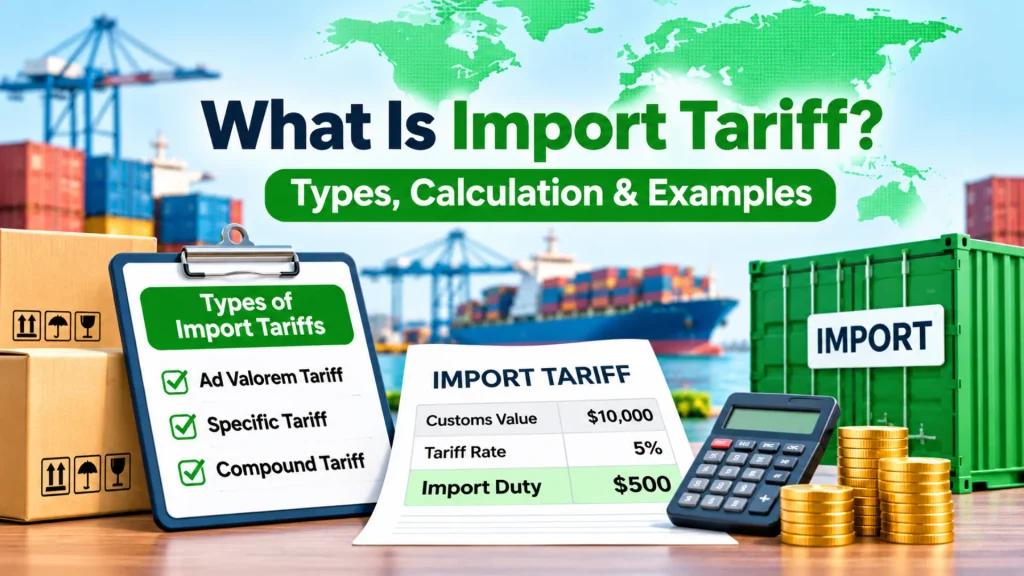
For example, suppose a US retailer imports merchandise with a customs value of $10,000. If the applicable import duty were 5% of that value, the basic tariff calculation would produce a duty of $500. This is a hypothetical example rather than a statement about the current tariff rate for any specific product. The actual amount payable could also involve additional duties, customs fees, or other charges depending on the shipment.
Import tariffs form part of a country’s broader trade policy. Governments may use them to generate revenue, influence the competitiveness of imported merchandise, or respond to particular trade practices. However, a tariff does not automatically prevent a product from entering a country. In many cases, importation remains permitted as long as the merchandise satisfies the applicable customs and regulatory requirements.
An important point for beginners is that the tariff rate is not determined solely by the country where a product was shipped from. The merchandise’s classification and legally determined country of origin can both matter, along with any applicable preferential treatment or additional trade measures. This is why an accurate product description and tariff classification are essential before calculating an importer’s expected costs.
How Do Import Tariffs Work?
Import tariffs generally apply when merchandise enters a country under a customs procedure that requires duties to be assessed. In the United States, imported products are classified under the Harmonized Tariff Schedule of the United States (HTSUS), which provides the basic tariff structure. US Customs and Border Protection (CBP) administers customs entry requirements and applies relevant laws when determining the treatment of imported goods.
The import process begins with information about the merchandise, including its description, classification, customs value, and country of origin. These details are used to determine the relevant tariff provisions and whether additional requirements apply. The importer of record or an authorized customs broker normally prepares the necessary customs entry information and coordinates applicable duty obligations.
For example, a business importing household accessories from an overseas manufacturer must determine the appropriate classification for those products. If the tariff provision uses a percentage-based rate, the customs value provides the basis for calculating the ordinary duty. However, the importer may also need to investigate additional tariffs or trade measures associated with the merchandise or its origin.
The important lesson is that an import tariff should be treated as part of the overall landed cost rather than as a charge that can be ignored until delivery. A business that calculates profitability using only the supplier’s price and freight costs may underestimate its total expenses. Researching the likely duty treatment before placing a purchase order provides a more reliable basis for commercial decisions.
Why Do Governments Impose Import Tariffs?
Governments impose import tariffs for several reasons, and the purpose can differ according to the products and trade policies involved. Some tariffs are primarily designed to collect revenue, while others are intended to influence trade conditions or address specific economic concerns. A country may also apply additional duties in response to particular trade practices or under specific legal authorities.
Generating Government Revenue
Import tariffs provide a source of government revenue by collecting duties on qualifying goods entering the country. Customs authorities administer these charges according to the applicable legal provisions. The amount collected depends on the merchandise being imported, its customs value or quantity, and the relevant duty rates.
For example, a percentage-based tariff produces a larger duty amount when the taxable customs value increases, assuming the rate remains unchanged. This means a shipment valued at $20,000 would generate more duty than a shipment valued at $5,000 under the same percentage rate. However, the actual calculation depends on the legally applicable customs value and the correct tariff provisions.
Supporting Domestic Industries
Tariffs can make certain imported products more expensive relative to comparable goods produced domestically. Governments may use this effect as part of policies intended to support domestic industries or influence purchasing decisions. The economic results are not always straightforward because manufacturers may also depend on imported raw materials, parts, and equipment.
For example, a tariff on imported finished products might affect retailers and consumers differently from a tariff on imported industrial components. If domestic manufacturers rely on those components, higher input costs may influence their production expenses. The overall impact depends on how businesses and consumers respond to the change in prices.
Responding to Trade Practices
Some additional duties are associated with trade remedy laws intended to address particular practices or conditions in international commerce. Antidumping duties, for example, can apply to merchandise covered by an applicable order following the relevant investigation and determinations. Countervailing duties are another form of trade remedy associated with certain subsidized imports.
These duties are not simply interchangeable with the ordinary tariff rates displayed in a product’s basic HTS classification. The relevant orders, product scope, origin, and other requirements must be evaluated separately. Importers dealing with affected merchandise should consult official trade remedy information and qualified professionals where necessary.
Types of Import Tariffs Explained
Not every import tariff is calculated in the same way. Some are based on the value of merchandise, while others depend on physical quantities such as weight, volume, or number of units. Understanding these structures is useful because two shipments with the same commercial value can produce different tariff calculations when their quantities or applicable rates differ.
1. Ad Valorem Tariffs
An ad valorem tariff is calculated as a percentage of the merchandise’s applicable customs value. This is one of the most familiar types of import duty because the calculation resembles a percentage-based tax. The duty amount generally increases as the relevant customs value increases, assuming the tariff rate remains constant.
Consider a hypothetical shipment of electronic accessories with an applicable customs value of $8,000 and an ad valorem duty rate of 7%. Multiplying the value by 0.07 produces a duty of $560. If another shipment of the same merchandise had a customs value of $16,000 under the same applicable rate, the basic duty calculation would be $1,120.
These examples illustrate the calculation method rather than the current tariff rate for electronic accessories. Actual rates vary by product and legal circumstances, and other measures may apply. Businesses should therefore verify the relevant HTS provisions before using a percentage in their landed-cost calculations.
2. Specific Tariffs
A specific tariff is assessed as a fixed monetary amount per specified unit rather than as a percentage of customs value. The unit might be based on weight, quantity, volume, or another measurement defined in the applicable tariff provision. As a result, the duty calculation depends on the number of qualifying units rather than directly on their commercial price.
For example, imagine a hypothetical tariff of $0.40 per kilogram on a particular product. If an importer brings in 2,000 kilograms of that merchandise, the basic duty would be $800. The same fixed rate could produce the same duty amount for another shipment weighing 2,000 kilograms even if its commercial value were different.
This does not mean that specific duties are always financially better or worse than percentage-based duties. Their effect depends on the merchandise, quantity, and value. Importers need to pay attention to the tariff schedule’s stated unit of quantity and avoid assuming every rate is expressed as a percentage.
3. Compound Tariffs
A compound tariff combines an ad valorem component with a specific component. In this structure, the duty may include both a percentage of the merchandise’s customs value and a fixed amount calculated using a particular quantity. The two components are added together according to the relevant tariff provision.
Suppose a hypothetical compound tariff consists of 4% of the customs value plus $0.20 per unit. A shipment containing 1,000 units with a customs value of $10,000 would generate $400 from the percentage component and another $200 from the unit-based component. The combined illustrative duty would therefore be $600.
Compound tariffs demonstrate why importers should read the full duty-rate description instead of assuming every tariff can be calculated using one simple percentage. A tariff schedule might specify several components that must be applied together. Incorrectly overlooking one component can produce an inaccurate duty estimate.
Import Tariff Types Comparison
| Tariff type | How it works | Hypothetical example |
|---|---|---|
| Ad valorem | Percentage of customs value | 5% of $10,000 = $500 |
| Specific | Fixed amount per unit | $0.50 × 1,000 units = $500 |
| Compound | Percentage plus fixed amount | 4% of $10,000 + $0.20 × 1,000 = $600 |
The figures above are educational examples, not actual tariff-rate recommendations for particular merchandise. A real import calculation must use the correct current tariff provisions and applicable customs valuation rules. Depending on the shipment, additional duties or fees may also need to be considered.
What Is the Difference Between an Import Tariff and Customs Duty?
The terms import tariff and customs duty are often used interchangeably in everyday trade discussions, particularly when referring to charges imposed on imported merchandise. In general, an import tariff describes the duty imposed under the applicable tariff provisions, while customs duty is a broader term commonly used for the amount legally assessed on imported goods. Their practical meaning often overlaps in the context of ordinary import transactions.
However, neither term should automatically be treated as covering every charge associated with customs clearance. In the United States, CBP may collect customs duties as well as certain additional taxes and user fees. Charges such as the Merchandise Processing Fee and applicable Harbor Maintenance Fee are separate from the ordinary tariff rate itself.
For example, a business might calculate $500 in basic customs duties but still need to account for other government fees and commercial brokerage charges. Those additional amounts can affect the total cost of importing the shipment. Keeping the different charges separate in financial records can make landed-cost estimates more accurate.
Who Pays Import Tariffs?
One of the most common misunderstandings about tariffs concerns who actually pays them. In a typical US commercial import transaction, the importer of record is responsible for applicable customs duties, taxes, and fees under US customs requirements. A licensed customs broker may assist with filing and payment arrangements, but hiring a broker does not automatically transfer the importer’s legal responsibility.
For example, if a US company imports merchandise from an overseas manufacturer, the US importer will generally need to satisfy the applicable entry obligations. The foreign supplier may have agreed to pay certain shipping or import-related costs under the commercial contract, but those arrangements must be distinguished from the legal responsibility established by customs law.
Another important distinction is the difference between the party legally paying the tariff and the parties who ultimately bear the economic cost. An importer may absorb the additional expense, increase retail prices, negotiate lower supplier prices, or make other commercial adjustments. Consumers, manufacturers, retailers, and suppliers may therefore experience different effects depending on how the market responds.
It is inaccurate to assume that a foreign government automatically pays US import tariffs simply because products originate in that country. Customs duties are assessed through the importing country’s customs system. The commercial and economic effects can extend beyond the importer, but that does not change how the legal duty obligation is administered.
How to Calculate Import Tariffs
Calculating an import tariff begins with identifying the correct tariff provision and establishing the appropriate customs value or quantity. Once those details are known, the basic calculation may be relatively straightforward. The challenging part is often determining which duty provisions actually apply and whether additional trade measures must be included.
Step 1: Determine the Correct HTS Classification
For goods imported into the United States, begin by identifying the product’s appropriate classification in the official Harmonized Tariff Schedule. The classification depends on factors such as the product’s material, construction, function, and the relevant legal interpretation rules. A familiar retail product name may not contain enough information to establish the correct provision.
The US International Trade Commission publishes the HTS, while CBP is responsible for interpreting and enforcing its provisions. An importer should therefore use the official tariff schedule as a starting point and consult CBP guidance when needed. A supplier-provided code may help identify possible classifications but should not automatically be treated as final.
Step 2: Establish the Applicable Customs Value
For a percentage-based tariff, the relevant customs value is essential to the calculation. In the United States, customs valuation commonly begins with the transaction value of imported merchandise, subject to the applicable legal rules and required adjustments. The customs value is not necessarily identical to every amount shown on a supplier’s invoice or to the total delivered price.
For example, transportation and insurance costs can require separate consideration under the relevant customs valuation rules. Other transaction-related payments or adjustments may also affect the customs value. Importers should avoid applying a percentage to a guessed amount without first confirming the correct valuation basis.
Step 3: Identify the Applicable Duty Rate
After identifying the classification and customs value, examine the relevant rate in the current HTS. The schedule includes different rate columns and provisions for particular trade treatment. Country of origin and eligibility for preferential programs can affect which treatment applies, and some merchandise may be subject to additional duties or trade measures.
Do not stop after finding a familiar percentage in an online search result. Check whether the product has additional requirements under other provisions, including relevant Chapter 99 measures where applicable. Some trade remedy duties may also need to be investigated separately from the ordinary HTS duty rate.
Step 4: Apply the Correct Calculation
For an ad valorem tariff, multiply the applicable customs value by the duty rate expressed as a decimal. A 6% rate becomes 0.06 in the calculation. If the customs value is $12,000, the basic duty would be $720.
For specific duties, multiply the applicable physical quantity by the stated monetary rate. Compound duties require calculating each component and combining the results. The actual shipment must be evaluated using its legally applicable rate and units, rather than choosing whichever method produces the lowest amount.
Step 5: Include Other Applicable Charges
Once the basic duty has been estimated, consider any additional applicable tariffs, taxes, and customs user fees. The Merchandise Processing Fee and, for certain vessel imports, the Harbor Maintenance Fee may be relevant. Commercial expenses such as customs brokerage, freight forwarding, transportation, and storage should also be included when estimating the overall landed cost.
| Cost component | Hypothetical amount |
|---|---|
| Merchandise customs value | $10,000 |
| Illustrative ordinary duty at 5% | $500 |
| Illustrative additional duty at 10% | $1,000 |
| Combined illustrative duties | $1,500 |
| Brokerage, processing, and other charges | Calculated separately |
This table demonstrates how multiple duties can add to the import cost, but it does not establish that a particular shipment is subject to those rates. Actual additional-duty calculations, exemptions, and applicable bases must be confirmed under the current legal rules. An importer should not simply add percentages without checking how each measure applies.
Practical Import Tariff Example for a US Small Business
Consider a hypothetical US retailer that plans to import 2,000 reusable household products from an overseas manufacturer. The supplier quotes $4 per unit, creating a merchandise purchase price of $8,000. The retailer also receives an estimate for international shipping and customs brokerage services. Before confirming the order, the business wants to understand how an import tariff could affect its expected profitability.
For illustration, assume that the applicable customs value is $8,000 and the ordinary ad valorem duty rate is 5%. The basic duty calculation would be $400. If a separately applicable additional duty were 10% of the same value, that would add another $800, bringing the illustrative combined duties to $1,200 before other applicable fees and charges.
The retailer should then add the remaining eligible import expenses when estimating the shipment’s landed cost. These may include freight, insurance, brokerage, and other government or logistical charges. If the company expects to sell each product at a fixed retail price, the additional costs may influence its expected gross margin.
This example demonstrates why a low overseas purchase price is not enough to evaluate an import opportunity. Two suppliers offering similar products at similar prices may produce different landed-cost estimates because of transportation arrangements, product classification, origin, or applicable trade measures. Accurate research before purchasing can help a business avoid basing its financial decisions on incomplete cost estimates.
How Do HS Codes Affect Import Tariffs?
HS codes are important because they provide the classification framework used to organize traded merchandise. The internationally standardized Harmonized System contains six digits, while the United States extends that framework through the HTSUS. The relevant US eight-digit tariff provisions establish legal tariff classifications, with additional digits used for statistical reporting.
A product’s classification influences which ordinary tariff provisions apply. However, classification should not be determined solely by choosing a code that appears to have a lower duty rate. The correct provision must reflect the actual merchandise and the applicable legal interpretation rules.
For example, two products marketed as household containers may fall under different classifications if their materials, functions, or construction differ. A plastic product should not automatically be assigned the same classification as a vacuum-insulated metal product simply because both can hold liquids. The correct classification requires a review of the relevant tariff descriptions and legal notes.
For a deeper explanation of the classification process, read GrazJob’s guide “How to Find the Correct HS Code for a Product.” Understanding the classification process makes it easier to interpret tariff information and avoid comparing duty rates for products that are not legally equivalent.
Why Do Import Tariff Rates Differ Between Countries?
Import duty treatment can differ depending on the country of origin of the merchandise and the trade laws that apply to a particular transaction. Governments may maintain preferential trading arrangements with certain countries or apply additional duties under other legal authorities. As a result, otherwise similar goods may receive different tariff treatment depending on their legally established origin and eligibility for the relevant provisions.
The distinction between a shipment’s origin and its shipping location is important. Goods shipped from a warehouse in one country may have been manufactured or substantially transformed elsewhere. The applicable country-of-origin rules determine which country is relevant for particular customs purposes.
For example, a company should not assume that routing merchandise through a different country changes its legal origin or eliminates an applicable tariff. Customs authorities apply origin rules and may review supporting manufacturing and transaction records. Accurate declarations matter because an incorrect origin claim can create customs compliance problems.
How Do Additional US Tariffs Work?
In addition to ordinary customs duties, certain imported goods may be subject to additional tariff measures under applicable US trade laws. These measures may be associated with particular products, origins, or legal actions. Some are reflected through specific HTS provisions, including relevant Chapter 99 measures, while other trade remedy duties are administered through separate legal processes.
The exact requirements can change over time because tariff measures may be introduced, modified, suspended, or removed. This makes it risky to rely on an article that quotes a duty percentage without specifying the applicable date, product, and legal basis. Importers should check official government sources when assessing a current shipment.
Antidumping Duties
Antidumping duties may apply to goods covered by an effective order following the relevant investigation and legal determinations. These measures address particular circumstances involving imports sold at less than the applicable fair-value benchmark under US trade remedy law. The scope of an order can depend on detailed product descriptions and other factors, so the general product name alone is not always sufficient.
Importers should not assume that the ordinary HTS duty rate includes all applicable antidumping duties. USITC guidance explains that antidumping and countervailing duty rates are not ordinary customs tariff rates displayed within the basic HTS structure. Businesses should consult the relevant Department of Commerce and CBP resources when determining whether an order applies.
Countervailing Duties
Countervailing duties are trade remedy measures associated with certain subsidized imports under applicable laws. Like antidumping duties, they are generally connected to specific investigations, determinations, and orders. Their applicability depends on the merchandise covered and the relevant legal requirements.
A business importing goods subject to a countervailing duty order may face additional financial obligations beyond ordinary customs duties. These measures can involve cash deposits and subsequent administrative proceedings. Importers should therefore research potentially applicable trade remedy orders before relying on a basic tariff estimate.
Are Import Tariffs the Same as Import Taxes and Customs Fees?
Import tariffs are one category of government charge associated with imported goods, but they are not identical to every import-related tax or fee. CBP may collect certain additional taxes and user fees depending on the merchandise, shipment type, and applicable legal requirements. The distinction matters because a product’s tariff rate alone may not reveal the total government charges associated with entry.
For example, the Merchandise Processing Fee is a customs user fee rather than an ordinary import tariff. Certain vessel shipments may also involve a Harbor Maintenance Fee, while some merchandise can be subject to federal excise taxes. The applicability and amount of these charges depend on current legal provisions.
Businesses should separately record ordinary duties, additional duties, government fees, and commercial service expenses when calculating landed costs. This makes it easier to understand which charges are associated with tariff policy and which arise from transportation or customs processing. It also helps prevent the common mistake of referring to every import-related payment as a tariff.
Do All Imported Products Have Tariffs?
Not every imported product carries a positive ordinary customs duty rate under every circumstance. Some tariff provisions have duty-free treatment, while others include ad valorem, specific, or compound duty structures. Preferential programs or other legally applicable provisions may also affect the treatment of certain shipments.
However, a duty-free ordinary HTS rate does not automatically mean the shipment has no import-related charges. Additional trade measures, customs fees, or other requirements can still be relevant depending on the merchandise and circumstances. Importers need to evaluate the complete applicable treatment rather than relying only on the basic duty column.
It is also important to avoid outdated assumptions about low-value shipments. US rules regarding de minimis duty-free treatment changed significantly in 2025, and importers should verify the current requirements rather than assuming that every small shipment qualifies for a general $800 duty exemption. The applicable rules and any exceptions should be checked for the specific entry.
How to Check Import Tariffs in the United States
For US importers, the official Harmonized Tariff Schedule is an essential starting point for tariff research. The USITC provides online access to tariff provisions and supporting information at hts.usitc.gov. Businesses should use the relevant product details to locate possible classifications and review the applicable legal text.
Once a possible HTS classification has been identified, examine the ordinary duty provisions and any additional references or notes. Check the product’s country of origin and determine whether additional trade measures may apply. If the classification is uncertain, review published CBP rulings or seek professional assistance rather than selecting a number solely because its duty rate appears favorable.
Other official government resources can help explain particular trade measures and customs requirements. CBP administers customs laws and can provide binding classification rulings under its established procedures. The Department of Commerce publishes information relating to trade remedy investigations and orders. Using these sources together provides a stronger basis for import planning than relying on a general online tariff calculator alone.
Common Import Tariff Mistakes to Avoid
Tariff problems often begin with simple assumptions made during purchasing or shipment planning. A buyer may accept a supplier’s classification without verification, estimate duties using an outdated rate, or overlook additional measures associated with the goods. These errors can affect profitability and may create customs compliance issues.
Using an Incorrect HS or HTS Code
A supplier may provide a commodity code used in its own country, but the additional national digits may not correspond to the correct US reporting number. A classification may also be inappropriate if the supplier has described the product inaccurately. Importers should verify the merchandise against the relevant tariff descriptions and classification rules.
Choosing a classification primarily because it carries a lower duty rate is especially risky. Classification should reflect the actual characteristics of the goods. Businesses should retain sufficient product information and seek professional guidance when a significant classification question remains unresolved.
Assuming the Ordinary Duty Rate Is the Total Tariff
An importer might find a 5% ordinary duty rate and conclude that the complete tariff exposure is 5%. However, additional duties or other measures may apply under separate provisions. The final amount can therefore differ from the first figure displayed in a tariff search.
A more reliable approach is to check whether the product and origin trigger other relevant measures. This may involve examining Chapter 99 provisions, trade remedy orders, or current official notices. Customs brokerage advice can be valuable when several measures potentially apply.
Ignoring Country-of-Origin Rules
The country from which goods are shipped does not necessarily establish their legal country of origin. A product may be manufactured in one country and transported through another before reaching the United States. Customs origin rules determine how the merchandise is treated for the relevant legal purposes.
Incorrect origin information can affect duty treatment and other compliance requirements. Businesses should request accurate manufacturing and sourcing information from suppliers rather than assuming that the warehouse location determines the applicable tariffs.
Relying on Outdated Tariff Information
Tariff schedules and additional measures can change, which means a rate used for a previous shipment may not remain applicable. Old spreadsheets and third-party articles may contain figures that were correct at publication but no longer reflect current law. This is particularly important for businesses importing products affected by changing trade measures.
Importers should verify current requirements before finalizing significant orders or customs declarations. Maintaining classification and tariff records is useful, but those records should include review dates and supporting official references.
Forgetting Landed-Cost Expenses
A business may calculate the customs duty correctly while overlooking freight, brokerage, insurance, or other import-related expenses. These charges can materially affect the final cost per unit. A product that initially appears profitable may become less attractive once all relevant expenses are included.
Separating the different cost components can make the estimate easier to review. It also allows businesses to compare suppliers using a more complete financial picture rather than relying on purchase prices alone.
How Do Import Tariffs Affect Businesses and Consumers?
Import tariffs can influence businesses by increasing the cost of certain imported merchandise. Importers may respond by adjusting selling prices, negotiating with suppliers, changing their sourcing strategy, or absorbing some of the additional expense. The actual response depends on market competition, consumer demand, contractual arrangements, and the availability of alternative products.
For a small retailer, an increase in the landed cost of imported inventory can affect gross margins. If the business keeps its retail prices unchanged, the additional cost may reduce the margin on each sale. If it raises prices, customer demand or competitive positioning may change.
Manufacturers can also be affected when they import components or materials used in domestic production. A tariff on imported inputs may increase production costs even when the finished goods are manufactured locally. For this reason, the economic effects of tariffs can extend across supply chains rather than affecting only businesses selling finished imported products.
Consumers may experience some of these costs through retail pricing, but the degree of pass-through varies. It would be inaccurate to assume that every tariff increase is transferred entirely to customers or that every importer absorbs the whole amount. Economic outcomes depend on the circumstances of the particular market.
Final Thoughts
Understanding what is import tariff makes it easier to recognize how customs duties affect international purchasing decisions. Import tariffs can be based on merchandise value, quantity, or a combination of both, and their application depends on the relevant tariff provisions. The correct product classification, country of origin, customs value, and additional trade measures all matter when calculating the amount payable.
For US businesses, researching the Harmonized Tariff Schedule is an important starting point, but the ordinary duty rate should not be treated as the complete import cost. Additional duties, user fees, transportation expenses, and other requirements may affect the final landed cost. Accurate planning means understanding these components before placing a substantial overseas order.
If you’re preparing to import merchandise, begin by gathering detailed product information and confirming the appropriate classification. Review the current official duty provisions, identify any additional measures, and calculate the likely cost of bringing the goods to their final destination. When the shipment involves complicated trade rules or significant financial exposure, qualified customs guidance can help you make a more informed decision.
Frequently Asked Questions About Import Tariffs
What is import tariff in simple terms?
An import tariff is a customs duty imposed by a government on certain goods brought into the country from abroad. It may be calculated as a percentage of the merchandise’s customs value, a fixed amount per unit, or a combination of both. The applicable duty depends on the product classification and relevant trade laws. Importers should check the official tariff schedule before estimating their obligations.
Who pays import tariffs in the United States?
The importer of record is generally responsible for the applicable customs duties, taxes, and fees associated with a US import entry. A customs broker may assist with the declaration and payment arrangements, but the importer retains important legal responsibilities. The economic cost may ultimately be shared or passed along through commercial pricing decisions. This is different from assuming that a foreign government directly pays the import tariff.
How are import tariffs calculated?
The calculation depends on the type of duty specified in the applicable tariff provision. An ad valorem tariff uses a percentage of customs value, while a specific tariff uses a fixed amount per quantity or measurement. A compound tariff combines both methods. Importers must also check whether additional duties and other charges apply to the shipment.
Are import tariffs the same for every country?
No. Tariff treatment can differ according to the merchandise’s legally determined country of origin and the relevant trade provisions. Preferential arrangements, additional tariffs, and other legal requirements may affect the applicable rate. Businesses should not assume that similar products shipped from different countries always receive identical treatment. The current official rules must be checked for each transaction.
What is the difference between a tariff and a customs duty?
The terms are often used interchangeably when describing duties imposed on imported goods. A tariff commonly refers to the rate or duty established through the relevant tariff provisions, while customs duty can describe the amount assessed on a shipment. However, neither term automatically includes every government fee, tax, or commercial charge associated with importing. Separating those expenses is useful when calculating landed costs.
Can a product have a 0% import tariff?
Yes. Some products may have an ordinary duty rate of “Free” under the applicable tariff provisions. However, that does not automatically establish that the shipment is exempt from additional trade measures, customs user fees, or other regulatory requirements. The complete customs treatment depends on the merchandise and circumstances. Importers should verify the current provisions before assuming no charges apply.
How do I check import tariffs for a product?
For US imports, begin with the official Harmonized Tariff Schedule published by the USITC. Identify the correct classification, review its ordinary duty provisions, and check whether additional measures apply. Country of origin and customs value are also important factors. When the classification or applicable treatment remains uncertain, consult CBP guidance or a qualified customs professional.
Do import tariffs increase product prices?
Import tariffs can increase the cost of imported merchandise and may influence the prices businesses charge. Some importers pass part of the additional expense to customers, while others absorb costs or negotiate with suppliers. The outcome depends on market conditions and business decisions. It is therefore not accurate to assume that every tariff leads to an identical retail price increase.